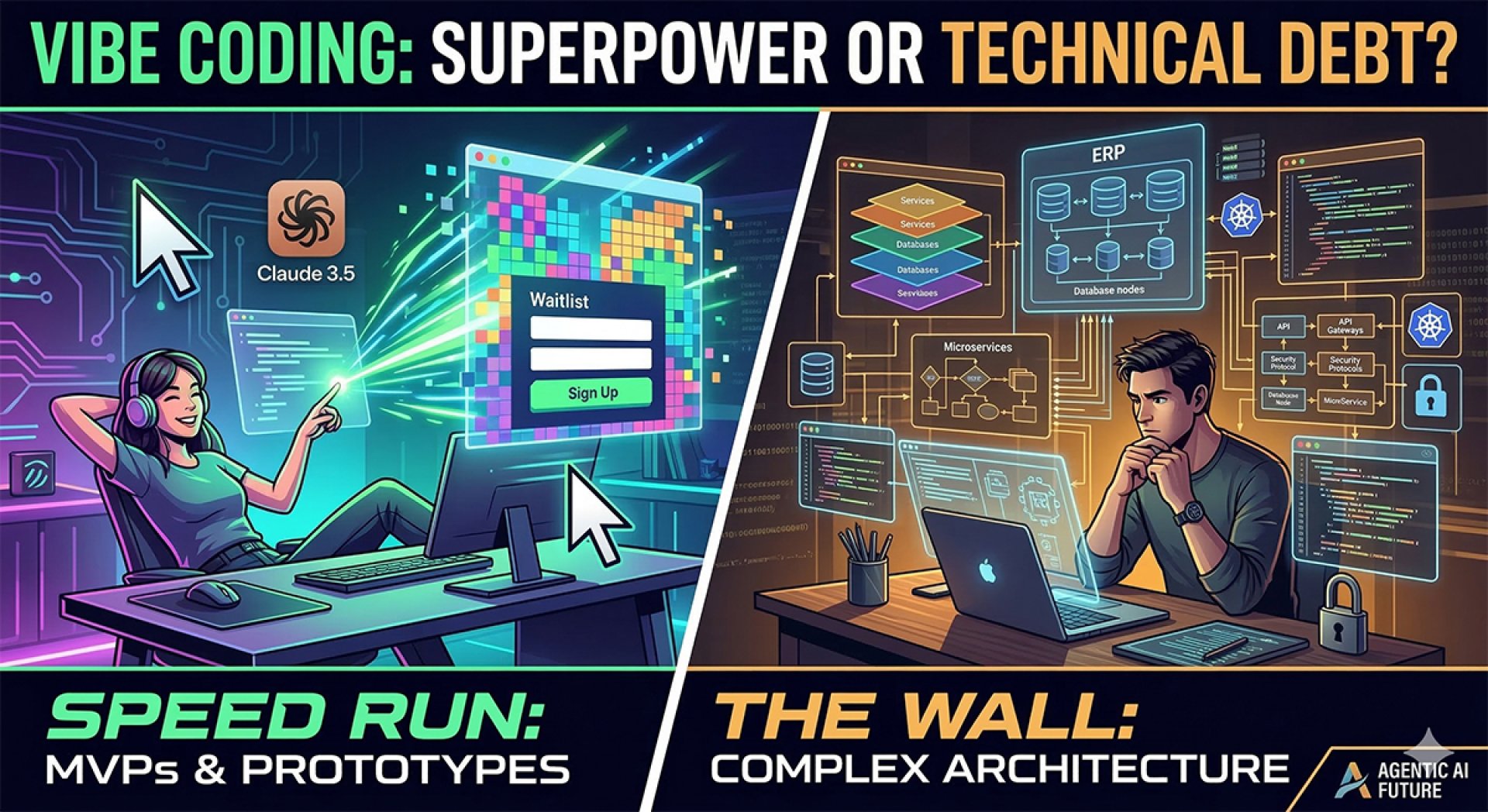
Forget manual syntax grinding for a second. There’s a new workflow dominating the dev-sphere: Vibe Coding.
If you’ve been scrolling through X (Twitter) or hanging out in founder circles, you’ve seen it. It’s the art of using LLMs (Claude 3.5 Sonnet, Cursor, Bolt.new) to manifest applications through natural language and "vibes" rather than writing every line of boilerplate code yourself.
But is it a superpower for junior devs, or a trap? Let’s break it down.
What Exactly is Vibe Coding?
Vibe coding is High-Level Declarative Development. Instead of worrying about how to map a forEach loop or handle a specific API fetch state, you describe the intent, the aesthetic, and the logic flow to an AI Agent.
The Builder's Concept: You aren't just using a "copilot"; you are acting as a Product Architect while the AI acts as the Senior Engineer. If the vibe is right, the app works.
The Use Case: When to Vibe
Vibe coding isn't a silver bullet; it’s a specialized tool for specific scenarios:
- The "Speed Run" (MVP & Landing Pages): Need a SaaS landing page with a waitlist and Stripe integration by lunch? Vibe coding wins. It handles the CSS grids and basic backend routing in seconds.
- Simple Utility Apps: CRUD apps, personal dashboards, or simple Chrome extensions.
- Prototyping: Validating an idea before committing weeks of manual "clean code" architecture.
The Wall: Where Vibes Die
You cannot "vibe" your way through an ERP system or a high-frequency trading engine. Here’s why:
- Architectural Integrity: Complex systems require deep knowledge of database normalization and microservices—things an LLM might "hallucinate" into a spaghetti mess.
- Debugging the Invisible: When a complex state management bug hits in a 50-component app, you can't just tell the AI "fix the vibe." You need to understand the Virtual DOM and network headers.
Pros vs. Cons for New Developers
| Pros | Cons |
|---|---|
| Instant Gratification: You see results fast, which keeps motivation high. | The "Black Box" Problem: You might ship code you don't actually understand. |
| Focus on Product: You learn what to build and why, rather than just how to syntax. | Debugging Paralysis: If the AI fails, a junior without fundamentals is stuck. |
| Market Relevance: Learning to use AI agents is a 2026 core skill. | Technical Debt: AI code can be "messy" and hard to scale long-term. |
The Evolution: From Vibes to Agentic AI
We are moving past simple chat interfaces into Agentic AI. These are agents that don't just write code; they Plan, Execute, and Test code autonomously.
The Verdict: If you are a new dev, don't skip the basics, but don't ignore the "vibe." Use vibe coding to build 10 small projects this month. But when something breaks, dive into the documentation to understand why.
Vibe coding makes you a 10x Builder, but technical depth makes you unreplaceable.